
Camera Reviews
Olympus Mju-II Review: The Cult Compact with the f/2.8 Lens
Daydream Editorial
· 8 min read
Verdict
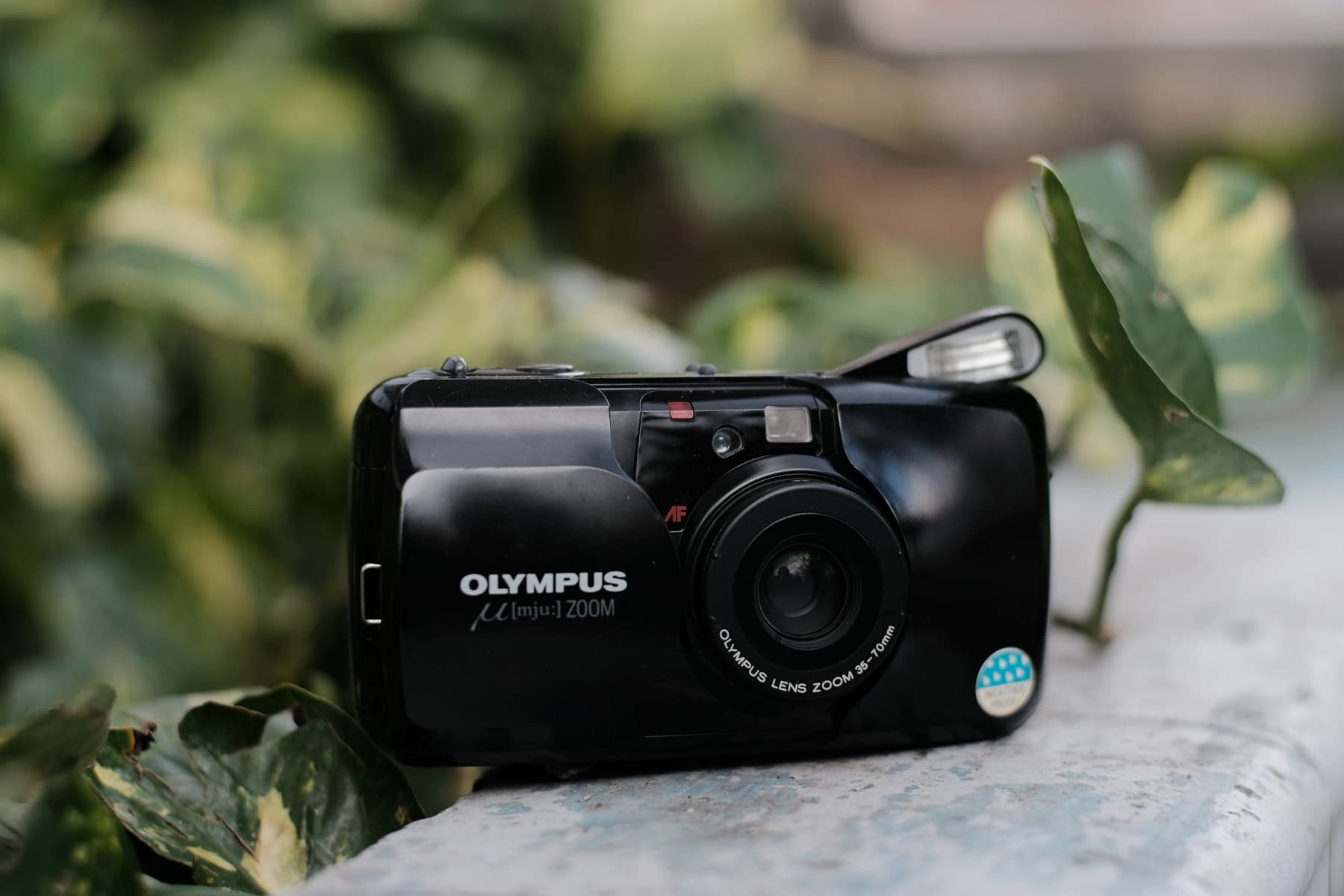
The Olympus Mju-II (Stylus Epic in US) is a weatherproof point-and-shoot delivering 35mm f/2.8 lens, multibeam autofocus, and splash-resistant body in a 135g package. Released 1997, it's one of the smallest, lightest 35mm cameras ever made. Shutter speeds 1/1000s to 4s. The autofocus is fast with 400+ focus steps. The lens is sharp edge-to-edge. Build quality is plastic but well-made. Flash resets to auto when you close the clamshell. At $250-350, it's expensive but delivers unmatched compactness with fast glass.
Film photographers debate whether the Olympus Mju-II's $250-350 price is justified: some call it the ultimate pocket camera with f/2.8 lens, weatherproofing, and multibeam autofocus, while skeptics dismiss it as overpriced "plastic junk" that doesn't offer enough control. The debate centers on whether convenience justifies premium pricing.
Background & Key Features
Olympus released the Mju-II in 1997 as an upgrade to the original Mju, positioning it as the ultimate pocket camera by combining compactness with professional-grade optics. It won European Camera of the Year 1997, which tells you something about how well it was received.
Key features include 35mm format, plastic body (silver or black), 35mm f/2.8 to f/11 lens (four elements), multibeam autofocus (active infrared plus passive), 1/1000s to 4s shutter range, 0.35m minimum focus (closer than most compacts), DX-coded ISO 50-3200, motorized film advance and rewind, built-in flash (five modes), weatherproof seals, 12-second self-timer, and wireless remote trigger. Dimensions are 108mm × 59mm × 35mm. Weight is just 135g. Uses a CR123A battery.
The Mju-II improved significantly over the Mju-I with a faster f/2.8 lens versus f/3.5, 1/1000s versus 1/500s shutter, 400+ focus steps versus 100, and added weatherproofing. At $250-350, it's pricey for a plastic point-and-shoot, but it delivers unmatched compactness with genuinely fast glass.
Design & Handling
The Olympus Mju-II feels surprisingly light at 135g with battery. At 108mm × 59mm × 35mm, it's one of the smallest 35mm cameras ever made and fits easily in jeans pockets without creating an awkward bulge. The plastic body is well-made with tight tolerances that feel solid. The champagne silver finish shows scratches as black lines (black versions hide wear better, which is worth considering if you're buying used).
The sliding clamshell cover opens smoothly with a satisfying click. The lens is always flush, extending only briefly to focus, which keeps the profile slim. The weatherproof seals are rubber gaskets, making it splash-resistant but not waterproof. Good for rain and snow, not for submersion or beach photography.
Controls are minimal: a large silver shutter button, two tiny rubber buttons on the back (flash mode and self-timer). The shutter button has good travel with a distinct half-press that's easy to feel. The rubber buttons are squishy and less satisfying. Pressing both together activates spot meter mode, which is clever but not intuitive.
The viewfinder is small, like looking through a keyhole. It's bright and clear but doesn't provide full coverage of the frame. No information except a crosshair for autofocus, parallax marks, green focus light, and orange flash indicator. The LCD shows frame counter, battery level, and flash or timer modes, which is all you really need.
How the Olympus Mju-II Shoots: Point-and-Shoot Simplicity for Street Photography and Travel Photography
Metering & exposure behavior
The automatic two-zone exposure control is consistently accurate, which is a relief when you have zero manual control. The meter reads EV 1-17. DX-coded ISO 50-3200 (defaults to ISO 100 if it can't read the DX code). The camera prioritizes faster shutter speeds over smaller apertures, favoring f/2.8 in dim light. This freezes motion nicely but sacrifices depth of field. It's great for street photography where you want to freeze action, less ideal for landscapes where you want everything sharp.
Exposures are genuinely spot-on even in challenging light. Your negatives come out perfectly exposed, which makes scanning easier. The meter handles backlit subjects well without blowing highlights. Spot metering mode (activated by pressing both buttons simultaneously) meters tightly around the center crosshairs, which is useful for high-contrast situations like shooting into windows.
There's no exposure compensation dial, which is frustrating. To overexpose by one stop, you must DX-hack the film canister by taping over certain contacts. This locks you to that override for the entire roll, so plan accordingly.
Focusing experience
The multibeam autofocus is fast and accurate, which is impressive for a point-and-shoot. Active infrared handles close distances, passive phase-detection handles longer distances. The system has 400+ focus steps, one of the best in any point-and-shoot from this era. Focus acquisition is quick: half-press locks focus, recompose, shoot. Hit rate is 98%+, which means you'll rarely miss a shot due to focus.
The autofocus can miss in specific situations: reflective surfaces (glass, mirrors, wet streets), high-contrast edges, and repeating patterns. When it misses, it misses badly, with focus off by meters. This happens rarely but frustratingly, usually when you're shooting something important.
The lens doesn't move at half-press, it moves after full press. This keeps the camera silent until you actually shoot, which is great for stealth, but it introduces slight lag. Generally not troublesome, but it can make capturing fleeting moments harder if you're not anticipating it.
The viewfinder doesn't show focus distance, so you're essentially guessing whether focus is correct. Thankfully it's accurate 99% of the time, so you learn to trust it. A green light confirms focus lock. Blinking green means focus failed (and blocks the shutter, which can be annoying).
Lens character & image quality
The 35mm f/2.8 lens is sharp edge-to-edge when stopped down. Four elements in four groups, minimal vignetting, chromatic aberration is well-corrected, flaring is minimal, and distortion is nearly zero. It's a clean, clinical lens.
At f/2.8 (wide open), the outer zones lack contrast and show field curvature. The overall impression holds up at close distances but lacks sharpness at distance. The camera shoots wide open often with ISO 100, which is the lens's weakness. You'll notice softer edges in bright daylight shots.
Stopped down to f/5.6 or f/8, the lens is genuinely exceptional. Sharp corner to corner, excellent contrast, pleasant color separation. The bokeh is appealing despite the three-blade diaphragm, which is impressive.
The lens focuses as close as 0.35m, closer than the Contax T2, which allows nice portraits and detail shots. Pro tip: the supplied lanyard is 1.5ft long, use it as a distance measure for minimum focus.
On Kodak Gold 200, the lens delivers beautiful golden tones. On Kodak Portra 400, skin tones are perfect. On Ilford HP5, contrast is strong and punchy. The lens doesn't have character like a Sonnar, but it's reliable and sharp, which is what you want in a point-and-shoot.
Film pairings that sing
- Kodak Gold 200 for travel and nightlife with beautiful golden tones
- Kodak Portra 400 for versatile shooting with perfect skin tones
- Ilford HP5 Plus for black and white street photography
- Kodak Tri-X 400 for classic black and white with strong contrast
- Fuji Superia 400 for budget color with good results
Best Uses: Travel Photography, Street Photography, and Nightlife
Best at: Travel photography (compact, weatherproof), street photography (fast autofocus), nightlife (f/2.8 lens, good flash), documentary work, everyday carry (fits in pocket)
Struggles with: Manual control (fully automatic, no exposure compensation), landscapes (prioritizes fast shutter), reflective surfaces (autofocus confused by glass/mirrors), long-term reliability (plastic body, electronic failure)
If this is you → pick this body:
- "I want smallest weatherproof camera" → Olympus Mju-II
- "I want cheaper alternative" → Olympus Mju-I ($130-170)
- "I want more control" → Olympus XA ($100-200)
Olympus Mju-II vs Olympus Mju-I, Olympus XA, and Yashica T4
The Olympus Mju-I offers similar compactness with an f/3.5 lens, 100 focus steps, and 1/500s shutter at $130-170. The Mju-II is objectively better with its faster f/2.8 lens, 400+ focus steps, 1/1000s shutter, and weatherproofing. It's worth the extra $100-150 if you can afford it.
The Olympus XA offers aperture priority, rangefinder focusing, and an F.Zuiko f/2.8 lens at $100-200. It has a better lens and more control, but it's heavier (240g), has no autofocus, and no weatherproofing. Choose the XA if you want control and don't mind manual focusing. Choose the Mju-II for convenience and speed.
The Yashica T4 offers an f/3.5 lens, excellent optics, and cult following at $300-500. It's larger, has no weatherproofing, but some photographers prefer its rendering. Choose the T4 for lens character if you like the Zeiss look. Choose the Mju-II for compactness and weatherproofing.
* Prices as of December 2025. Mju-II prices have risen significantly since 2020.
| Camera | Why choose it | Where it loses vs Mju-II | Typical used price* |
|---|---|---|---|
| Olympus Mju-I | $100-150 cheaper, still compact | Slower f/3.5 lens, 100 focus steps | $130-170 |
| Olympus XA | Aperture priority, better lens | No autofocus, heavier, no weatherproofing | $100-200 |
| Yashica T4 | Excellent lens character | Larger, no weatherproofing, more expensive | $300-500 |
Is the Olympus Mju-II Worth It in 2025?
As of December 2025, the Olympus Mju-II sells for $250-350, up from $30-50 in 2013. Prices have risen due to cult status and scarcity. This is expensive for plastic—you're paying premium for compactness.
Worth it if you shoot travel, street, or nightlife photography and value the smallest camera with fast glass and weatherproofing. The f/2.8 lens is genuinely fast. The multibeam autofocus is one of the best ever fitted. For photographers who want a camera that fits in any pocket, it delivers.
Not worth it if you need manual control (get Olympus XA), want better value (get Mju-I for $100 less), or prefer metal build (get Contax T2). Not worth it if you're on budget—many cheaper options deliver 90% of results.
For $250-350, you get the smallest weatherproof camera with f/2.8 lens. Fair value if compactness is priority.
The Bottom Line
Buy it if
- You shoot travel, street, or nightlife photography and want the smallest, lightest camera with fast glass and weatherproofing.
Skip it if
- You need manual control (get Olympus XA), want better value (get Mju-I), or prefer metal build (get Contax T2).
Consider it if
You want the best point-and-shoot autofocus ever made or need a camera that fits in any pocket and shoots in rain.
Frequently Asked Questions
Is the Olympus Mju-II worth it in 2025?
In 2025, the Olympus Mju-II sells for $250-350. It's worth it for travel, street, and nightlife photographers who value the smallest, lightest camera with fast f/2.8 glass and weatherproofing. The multibeam autofocus is one of the best ever fitted. Not worth it if you're on budget—get Olympus Mju-I for $130-170 (90% of the results for 50% less).
What is the difference between Olympus Mju-II and Mju-I?
The Mju-II has faster f/2.8 lens versus f/3.5, 1/1000s shutter versus 1/500s, 400+ focus steps versus 100, weatherproofing, spot metering, and is 10% lighter. The Mju-II is objectively better but costs $100-150 more. Choose Mju-I for budget. Choose Mju-II for best performance.
Is the Olympus Mju-II weatherproof or waterproof?
The Olympus Mju-II is splash-resistant (weatherproof) but not waterproof. Rubber seals protect from light rain and snow. Good for bad weather but not submersion. Don't drop it in water. The weatherproofing is unique among point-and-shoots and makes it ideal for travel photography in any conditions.
What battery does the Olympus Mju-II use?
The Olympus Mju-II uses CR123A battery (also called CR123). Readily available at most stores or online. Battery life is good—expect 20-30 rolls per battery. The camera is fully electronic—won't work without battery. Always carry spare batteries. Remove battery when storing camera for more than one month.
Why is the Olympus Mju-II so expensive?
The Olympus Mju-II is expensive ($250-350) due to cult status, scarcity, and unique features. It's the smallest weatherproof camera with f/2.8 lens and multibeam autofocus. Prices have risen from $30-50 in 2013 to $250-350 in 2025. Demand outstrips supply. Celebrity endorsements and social media hype have driven prices up.
What are common problems with the Olympus Mju-II?
Common issues: broken battery door (tape it closed), missing film window (glue it back), lens extending but not retracting (major electronic fault, likely unfixable), cracked bottom-left corner of film door (check for light leaks), degraded weatherproof seals (causes light leaks), failing LCD screen (sign of imminent failure). Buy from reputable sellers with return policies. Check seals and battery door before purchasing.
Olympus Mju-II vs Olympus XA – which is better?
The Mju-II has autofocus, motorized film transport, weatherproofing, and is lighter (135g vs 240g) at $250-350. The XA has aperture priority, rangefinder focusing, better lens, and more control at $100-200. Choose Mju-II for convenience and compactness. Choose XA for creative control and better lens.
What film should I use with the Olympus Mju-II?
The Olympus Mju-II excels with Kodak Gold 200 (beautiful golden tones for travel), Kodak Portra 400 (perfect skin tones for portraits), Ilford HP5 Plus (black and white street photography), Kodak Tri-X 400 (classic black and white), and Fuji Superia 400 (budget color). The f/2.8 lens handles ISO 100-400 well. Use ISO 400 for nightlife.
How do I turn off the flash on the Olympus Mju-II?
Press the flash button twice every time you open the clamshell cover. The camera resets to auto flash when powered off. This is the biggest annoyance—you must disable flash every time. The flash is powerful and works well as fill light, but it's overeager. For street photography without flash, get used to the two-press routine.
Related reading
Related Topics
Join the iOS Beta
Join the beta to be the first to experience authentic film photography with Daydream Film.