
Camera Reviews
Yashica T5 Review: Weatherproof Point-and-Shoot with Super Scope Viewfinder
Daydream Editorial
· 8 min read
Verdict
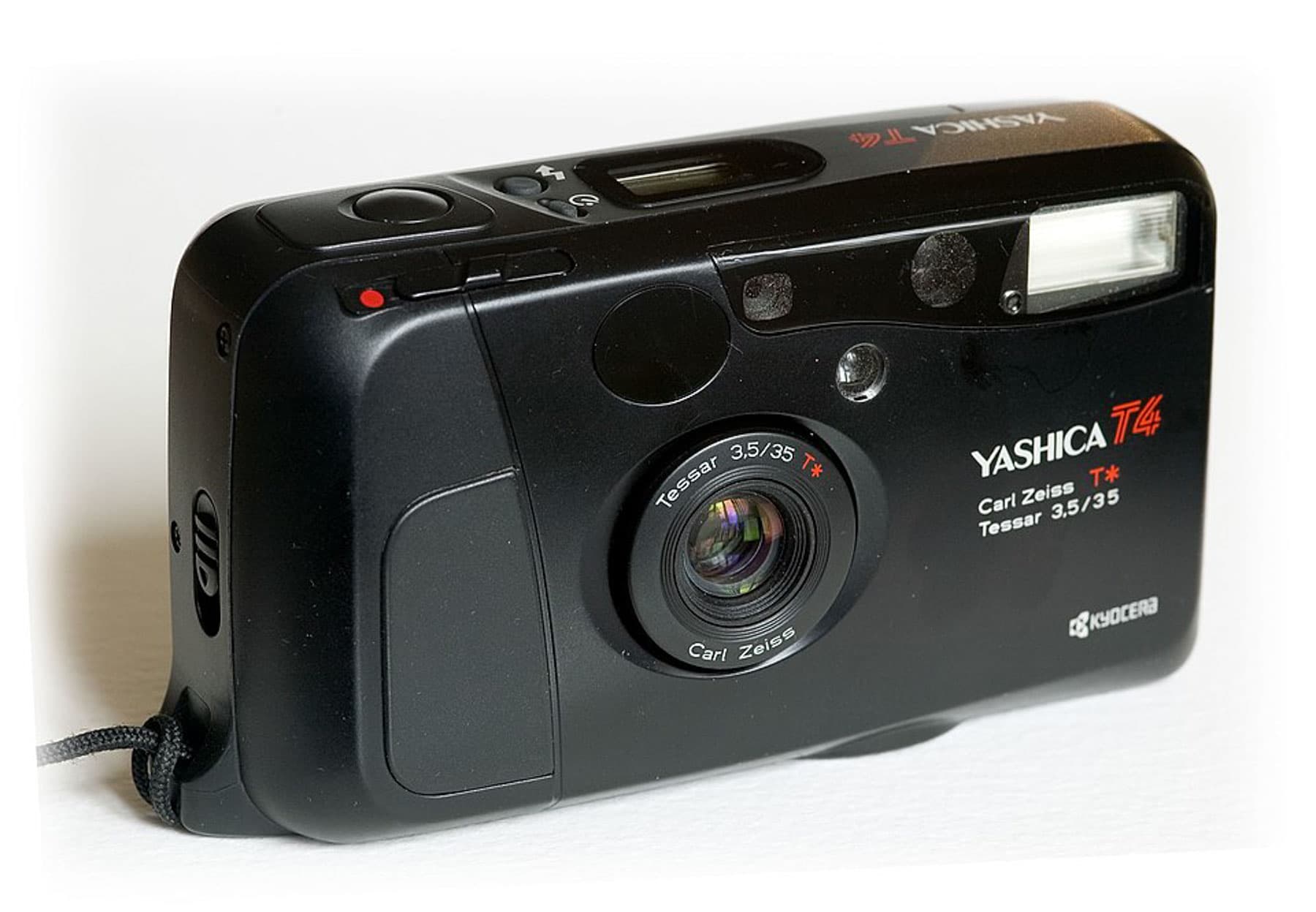
The Yashica T5 (also known as Yashica T4 Super or Kyocera T-Proof) is a weatherproof 35mm compact with a sharp Carl Zeiss Tessar 35mm f/3.5 lens, unique waist-level Super Scope finder, and close 0.35m focusing. It delivers excellent sharpness, reliable autofocus, and can handle rain and dust. The plastic body feels solid despite lacking premium materials. At $400-600, you're paying for unique features and cult status—the lens is fantastic, but the price reflects hype as much as capability.
Film photographers are split on the Yashica T5: some call it a weatherproof wonder with an exceptional Carl Zeiss lens and unique Super Scope finder, while others argue its $400-600 price is pure cult hype driven by Terry Richardson's fashion work. The debate centers on whether the T5's features justify costing double what similar compacts fetch.
Background & Key Features
Yashica released the T5 in 1995 as the upgraded T4 Super (marketed as T5 in some regions, Kyocera T-Proof in others), targeting photographers who wanted premium compact features with weatherproofing. It was the evolution of the T4, adding weather resistance and that unique Super Scope finder.
Key features include Carl Zeiss Tessar T* 35mm f/3.5 lens (closes to f/15.5), weatherproof seals (rain and dust resistant, not waterproof for submersion), Super Scope waist-level finder, 0.35m minimum focus distance (closer than most compacts), 1s to 1/700s shutter, three-point infrared autofocus, DX-coded ISO 50-3200, built-in flash with variable power, and CR123A battery. At 200g and 118×64×42mm, it's bulkier than non-weatherproof compacts but still pocketable.
The T5 gained cult status through Terry Richardson's fashion photography, driving prices from near-worthless in 2005 to $400-600 today. That's a dramatic price increase driven by association rather than capability.
Design & Handling
The T5 feels solid at 200g despite the plastic construction, substantial enough to inspire confidence but light enough for all-day carry. The rounded shape fits pockets but feels slightly awkward in hand, your middle finger sits where the lens extends. Rubber grip helps prevent slipping, which is appreciated. Weatherproof seals make doors tight-fitting, which takes some getting used to.
The viewfinder is bright but lacks eye relief, so glasses wearers may miss frame edges. Parallax markings are black (hard to see in low light, which is frustrating). The Super Scope on top shows approximate framing via mirrored reflection, tiny but bright, perfect for waist-level or overhead shots. It's the T5's party trick. Controls include power/lens toggle, shutter button (soft with easy half-press), flash mode, and self-timer.
The shutter fires with a quiet clack, excellent for candid work without drawing attention. Film advance whirrs audibly but not obnoxiously. The camera defaults to auto-flash on power-up, which is annoying if you prefer natural light. Weatherproof seals dampen motor noise, making it one of the quieter point-and-shoots despite the bulk.
How the Yashica T5 Shoots: Street Photography and Travel Photography Performance
Metering & exposure behavior
The dual-SPD metering system handles most lighting well, with automatic backlight compensation adjusting exposure or triggering flash when needed. The camera operates from EV 3.5-17 (ISO 100). In lower light (around 1/60s or slower), an orange bulb warns of slow shutter speeds, which is helpful. The camera tends to underexpose slightly before selecting very slow speeds, which often results in sharp but slightly dark images rather than blurred but correctly exposed ones. This is actually a smart trade-off. The leaf shutter and excellent shutter button design allow handholding down to 1/30s or even 1/15s comfortably.
Exposure and focus lock work via half-press and hold: point at your subject, half-press, recompose, and shoot. This solves most difficult lighting scenarios without fuss. A green bulb next to the viewfinder confirms focus lock (flashes if focus fails). The orange bulb indicates flash will fire or serves as a low light warning.
Focusing experience
The three-point infrared autofocus is excellent, extremely reliable with minimal missed focus. There's a slight delay before exposure (common on vintage autofocus compacts) as the lens moves to achieve focus, but it's quick enough for most situations. The 0.35m minimum focus distance is outstanding for close-up work like flowers, food, and details, making the T5 versatile beyond typical compact range.
The Super Scope finder adds creative possibilities that set the T5 apart. Looking down at the top of the camera, you can shoot from waist level (perfect for unobtrusive street photography), place the camera on the ground for low angles, or shoot overhead at events. The scope shows approximate framing with significant crop factor (the real image includes more on the sides). It's not precise, but with full auto exposure and focus, precision isn't necessary. You're shooting from the hip, literally. The scope is most useful within 1-3 feet, beyond that it's too small to be practical.
Lens character & shutter performance
The Carl Zeiss Tessar T* 35mm f/3.5 lens delivers excellent sharpness and contrast at close and mid distances. Sharpness maintains across the frame with no vignetting and no noticeable aberrations. Flare resistance is strong thanks to the T* coating. The triangular aperture blades render smooth, even bokeh at wide apertures, it doesn't swirl and resembles the Rollei 35 S rendering. Wide open at f/3.5, the lens is sharp and undistorted, which is impressive.
The 1s to 1/700s shutter range covers most situations without needing ND filters. Flash uses variable power to avoid over-exposure at close range, which is smarter than fixed-power flash. Five flash modes: auto (default), red-eye reduction, always-on (great for fill-flash in daylight), no flash, and infinity focus (disables flash and forces infinity focus for landscapes). The camera won't fire while flash charges, with the orange bulb blinking to warn you.
Film pairings that sing
- Kodak Portra 400 when you want flexible exposure latitude and natural skin tones
- Kodak Gold 200 for warm, saturated colors in good light
- Kodak Ektar 100 for vibrant colors and maximum sharpness
- Ilford HP5 Plus for flexible black-and-white exposure or Kodak Tri-X for punchier contrast
- Fuji Superia 400 for everyday shooting with extra speed
Best Uses: Street Photography, Travel Photography, and Creative Angles
Best at: Street photography (compact, quiet, Super Scope waist-level), travel photography (weatherproof, pocketable), close-up photography (0.35m focus), creative angles (Super Scope low/high perspectives)
Struggles with: Manual control (fully automatic), flash defaults (resets to auto), size (bulkier than non-weatherproof compacts), Super Scope precision (approximate framing), shutter lag (slight delay)
If this is you → pick this body:
- "I want weatherproof and Super Scope" → Yashica T5
- "I want same lens, cheaper" → Yashica T4 ($300-450)
- "I want premium build" → Contax T2 ($800-1,200)
Yashica T5 vs Yashica T4, Contax T2, and Olympus Mju II
The Yashica T4 is nearly identical with the same Carl Zeiss Tessar f/3.5 lens, but lacks weatherproofing and Super Scope. It's more compact and costs $300-450, which is $100-150 less. The Contax T2 offers premium titanium build, faster f/2.8 Sonnar lens, and manual controls at $800-1,200, which is double the price. The Olympus Mju II delivers similar size and sharp lens at $200-400, which is half the price.
Choose the T5 if you want the Super Scope and weatherproofing. Choose the T4 for the same lens at less money if you don't need weather resistance. Choose the Contax T2 for premium build and manual controls if budget isn't a concern. Choose the Mju II for value if you don't care about the Zeiss badge.
* Prices as of December 2025. T5 prices reflect cult status and Terry Richardson association.
| Camera | Why choose it | Where it loses vs Yashica T5 | Typical used price* |
|---|---|---|---|
| Yashica T4 | Same Carl Zeiss lens, slightly more compact, less expensive | No weatherproofing, no Super Scope, louder motor | $300-450 |
| Contax T2 | Premium titanium build, faster f/2.8 Sonnar lens, manual controls | 2x the price, less weatherproof, no Super Scope | $800-1,200 |
| Olympus Mju II | Similar compact size, sharp lens, less cult hype pricing | Slower f/3.5 lens, no Super Scope, no weatherproofing | $200-400 |
Is the Yashica T5 Worth It in 2025?
As of December 2025, the T5 sells for $400-600. This is cult pricing. The Carl Zeiss lens is fantastic—sharp, contrasty, reliable. The weatherproofing works. The Super Scope is genuinely unique. But you're paying $200-300 more than comparable compacts.
Worth it if you specifically want weatherproofing and Super Scope. The lens quality justifies $300-400, but $500-600 is pure hype. Alternatives: Yashica T4 ($300-450, same lens), Olympus Mju I ($150-300), Konica Big Mini ($200-350). One London shop couldn't sell 20 T5s in 2005; those same cameras fetch $400+ today.
Not worth it if you don't need weatherproofing or Super Scope. The T4 delivers 90% of the experience at lower cost. The price reflects Terry Richardson's influence as much as capability.
The Bottom Line
Buy it if
- You want weatherproof reliability, Super Scope creative shooting, and excellent Carl Zeiss lens. Can find one under $450. $400-450 is fair.
Skip it if
- You don't need weatherproofing or Super Scope (get T4), want manual controls (get Contax T2), or can't justify $400-600 for plastic (get Mju I).
Consider it if
You need weatherproofing for travel or want Super Scope for creative street photography.
Frequently Asked Questions
Is the Yashica T5 worth it in 2025?
In 2025, the Yashica T5 sells for $400-600. It's worth it if you specifically want weatherproofing and the unique Super Scope finder. The Carl Zeiss Tessar lens is fantastic—sharp, contrasty, reliable. But you're paying cult pricing driven by Terry Richardson's use. The lens justifies $300-400; anything over $500 is pure hype. Comparable alternatives like the Yashica T4 ($300-450, same lens without weatherproofing) or Olympus Mju I ($150-300) offer better value.
What's the difference between Yashica T5 and T4?
The T5 (also called T4 Super) has weatherproof seals, Super Scope waist-level finder, and slightly larger body (2mm thicker, 10g heavier). The T4 lacks weatherproofing and Super Scope but has the same Carl Zeiss Tessar f/3.5 lens, same autofocus, same features. The T4 is slightly more compact and costs $300-450 versus T5's $400-600. Choose T5 for weatherproofing and Super Scope; choose T4 for same lens at lower cost.
Is the Yashica T5 weatherproof or waterproof?
The T5 is weatherproof, not waterproof. It can be used freely in rain, snow, and dusty conditions thanks to hermetic seals protecting internals. However, it's not rated for water pressure—don't wash it under tap water or submerge it. The translucent Auto Lens Barrier doesn't prevent water from reaching the lens (by design) but keeps droplets off the glass. Wipe the camera with a damp cloth after exposure to elements.
What film works best with the Yashica T5?
The T5 handles any 35mm film well with DX-coded ISO 50-3200 (defaults to ISO 100 if not DX-coded). Best pairings: Kodak Portra 400 for versatile shooting with beautiful skin tones, Kodak Gold 200 for warm saturated colors, Kodak Ektar 100 for vibrant sharpness, Ilford HP5 Plus or Kodak Tri-X for black and white with excellent contrast. The Carl Zeiss lens renders sharp results with any film stock.
How does the Super Scope work on the Yashica T5?
The Super Scope is a small window on top showing approximate framing via mirrored reflection (like a TLR waist-level finder). It's technically a "brilliant finder" using direct mirror reflection with optics simulating the 35mm focal length. Perfect for low-angle shots (place camera on ground, look down), waist-level street photography (unobtrusive), or overhead shooting. The scope has significant crop factor—real image includes more on sides. Most useful within 1-3 feet; beyond that, it's too small to be practical.
Can the Yashica T5 handle street photography?
Yes, the T5 excels at street photography. It's compact, quiet (leaf shutter, dampened motor), fast autofocus, and the Super Scope enables unobtrusive waist-level shooting. The 0.35m minimum focus distance allows close-up details. The Carl Zeiss lens is sharp with good contrast. Downsides: slight shutter lag while focusing, no zone focus or manual controls, flash defaults to auto on power-up. Overall, it's an excellent street photography compact.
What are common problems with the Yashica T5?
Common issues: film transport failure (most common mechanical problem—confirm working transport before buying), flash defaults to auto on every power-up (annoying if you prefer flash off), tight film and battery doors due to weatherproof seals, slight shutter lag while autofocus engages, Super Scope is tiny and hard to use beyond 3 feet, no manual controls (fully automatic), power toggle can stiffen in rain. Cracks in plastic body render weatherproofing inactive.
Should I buy the Yashica T5 or Contax T2?
Choose the T5 for weatherproofing, Super Scope creative shooting, and lower price ($400-600 vs $800-1,200). Choose the Contax T2 for premium titanium build, faster f/2.8 Sonnar lens, manual controls, and superior build quality. The T2 is objectively better but costs double. The T5 delivers excellent results with unique features at half the price. If you don't need weatherproofing or Super Scope, consider the Yashica T4 ($300-450) instead.
Related reading
Related Topics
Join the iOS Beta
Join the beta to be the first to experience authentic film photography with Daydream Film.