
Camera Reviews
Pentax Spotmatic Review: The M42 SLR That Defined a Generation
Daydream Editorial
· 8 min read
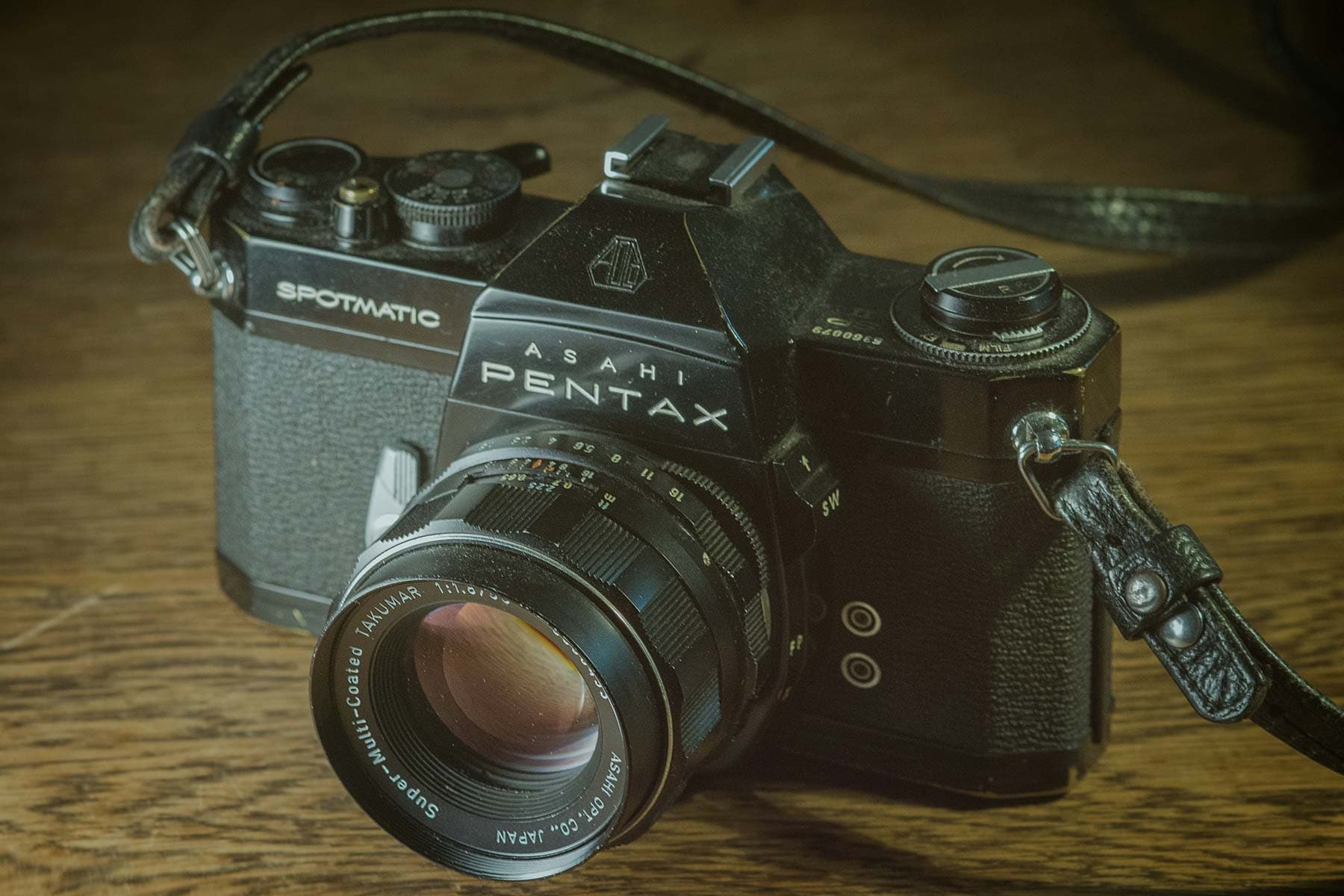
Verdict
The Pentax Spotmatic is a mechanical 35mm SLR delivering through-the-lens metering, M42 mount, and legendary Takumar lenses in a tank-like body. Released 1964, it brought TTL metering to the masses. Shutter speeds 1-1/1000s plus bulb. The viewfinder is bright with excellent microprism focus aid. Stop-down metering darkens the viewfinder but teaches exposure discipline. Build quality is exceptional—smooth controls, refined shutter. The Super-Takumar 50mm f/1.4 is phenomenal. At $50-100 with lens, it's the best value in film SLRs.
Film photographers debate whether the Pentax Spotmatic's stop-down metering is a dealbreaker: some call it cutting-edge simplicity that teaches exposure fundamentals, while others find the workflow tedious compared to open-aperture metering. The debate centers on whether the Spotmatic's legendary build quality and Takumar lenses justify the metering compromise.
Background & Key Features
Pentax released the Spotmatic in 1964 as Asahi Pentax's answer to professional SLRs, and it was revolutionary for its time. It was one of the first cameras with through-the-lens metering integrated into the body, which fundamentally changed how photographers approached exposure. Before the Spotmatic, you needed external meters or guesswork.
Key features include 35mm format, all-metal construction that feels bombproof, M42 screw mount (compatible with thousands of lenses from dozens of manufacturers), through-the-lens CdS meter (stop-down metering), 1 to 1/1000s shutter plus bulb, 1/60s flash sync, mechanical operation (battery only powers the meter), microprism focus aid, and self-timer. The Spotmatic family includes SP, SP500, SP1000, SPII, SPIIa, SPF (open-aperture metering), and Electro Spotmatic (aperture priority). Production lasted until 1976, with the chassis continuing in the legendary K1000 until 1997.
At $50-100 with a 50mm lens, it's hard to beat for value in mechanical SLRs. The M42 mount gives you access to Takumar, Zeiss, and hundreds of other lenses at bargain prices.
Design & Handling
The Pentax Spotmatic feels substantial at 681g with the 50mm lens. All-metal construction with deliberate controls that feel purposeful. Build quality is exceptional, not Leica level but beyond Canon, Nikon, or Olympus of the era. The controls feel like lathe adjusters, smooth and deliberate with satisfying resistance that inspires confidence.
Top-plate controls are simple and logical: rewind crank, shutter speed dial with ISO selector (20-1600 on SP, 20-3200 on SPII), shutter release, film advance lever with frame counter. The curved film advance lever is iconic and ergonomically perfect with smooth action that makes advancing film a pleasure. The self-timer is on the front. Flash sync ports are on the front (SPII added a hot shoe, which is more convenient).
The stop-down metering switch sits next to the lens mount. Push it up to activate the meter and stop down the aperture. This darkens the viewfinder but was cutting-edge in 1964. The workflow: focus wide open, push switch up, adjust shutter or aperture until the needle centers, release switch, shoot. You get used to it quickly, and it becomes second nature within a roll or two.
The viewfinder is bright and large, a real pleasure to use. The microprism focus aid is exceptional, honestly the best in any 35mm SLR from this era. Precise focusing is easy even with fast lenses. The meter needle appears on the right when activated. Your goal is to center it between the plus and minus marks.
How the Pentax Spotmatic Shoots: Manual Focus and Through-the-Lens Metering Performance
Metering & exposure behavior
Through-the-lens center-weighted metering is consistently accurate. The CdS cells sit behind the prism. Despite the "Spotmatic" name, it uses averaging metering with center bias, not spot metering. The meter reads from the focused image.
The meter is powered by PX400 mercury battery (1.35v, now discontinued). Use 1.5v silver oxide 387S cells—the Spotmatic includes voltage bridge circuitry that adjusts to 1.35v. The meter is reliable and accurate.
Stop-down metering means you meter at working aperture. This darkens the viewfinder, especially with small apertures. The workflow feels slow at first but teaches exposure discipline. You learn to see how aperture affects depth of field and exposure simultaneously. For students, this is invaluable.
Focusing experience
The microprism focus aid is the best in any 35mm SLR. Precise focusing is easy with fast lenses (f/1.4, f/1.8, f/2). The microprism loves light—in bright conditions, focusing is instant. In low light or with slow lenses (f/3.5), the microprism darkens. The matte field around the microprism works as backup.
Manual focus is smooth and deliberate. The Takumar lenses have buttery focus rings even 50 years later. The focus throw is long, allowing precise control. For street photography, zone focusing works perfectly.
Lens character & image quality
The Super-Takumar lenses live up to their legendary reputation. Exceptional optical quality, excellent multi-coating, and mechanical perfection that still feels smooth 50+ years later. The 50mm f/1.4 is phenomenal, sharp wide open, with incredible contrast and beautiful bokeh. By f/2.8, it's an optical scalpel. The 50mm f/1.8 is nearly as good and costs half as much. The 35mm f/3.5 is compact and sharp. The 135mm f/3.5 is wonderful for portraits, with creamy bokeh that rivals lenses costing ten times as much.
Early Super-Takumar 50mm f/1.4 lenses (1962) used radioactive thorium oxide glass, which sounds wild but was common at the time. These yellow over time but add unique character that some photographers love. Later SMC Takumar lenses don't yellow and include pins for open-aperture metering (only works on Spotmatic F, not the regular Spotmatic).
The M42 mount is universal, with thousands of lenses available from dozens of manufacturers. Zeiss, Carl Zeiss Jena, Schneider-Kreuznach, Voigtlander, Tamron, Vivitar, and hundreds more. The Spotmatic's deep mirror box accommodates most M42 lenses without issues.
On Ilford HP5, the Takumar lenses deliver strong contrast that's perfect for street photography. On Kodak Tri-X, blacks are rich and deep. On Kodak Ektar, colors are saturated and punchy. On Ilford FP4, you get fine grain with exceptional detail.
Film pairings that sing
- Ilford HP5 Plus for versatile black and white with strong contrast
- Kodak Tri-X 400 for classic black and white street photography
- Ilford FP4 Plus for fine-grained black and white with excellent detail
- Kodak Ektar 100 for saturated color with exceptional sharpness
- Fomapan 200 for budget black and white with good contrast
Best Uses: Student Camera, Street Photography, and Manual Focus Learning
Best at: Student photography (teaches exposure fundamentals), street photography (compact, reliable, fast focusing), portrait photography (50mm and 135mm excel), documentary work (mechanical reliability), black and white photography (Takumar contrast)
Struggles with: Low light focusing (microprism darkens), fast action (stop-down metering slows workflow), open-aperture metering (only Spotmatic F offers it), battery availability (PX400 discontinued, use 387S substitute)
If this is you → pick this body:
- "I want to learn manual exposure" → Pentax Spotmatic
- "I want open-aperture metering" → Pentax Spotmatic F ($80-150)
- "I want aperture priority" → Pentax K1000 ($100-200)
Pentax Spotmatic vs Pentax K1000, Canon AE-1, and Minolta SRT-101
The Pentax K1000 uses the same chassis with K bayonet mount, open-aperture metering, and hot shoe at $100-200. The K1000 is easier to use with a more streamlined workflow, but K-mount lenses cost more than M42. Choose the K1000 for convenience and easier metering. Choose the Spotmatic for lens selection and better value.
The Canon AE-1 offers aperture priority, open-aperture metering, and FD mount at $100-150. It's more automated but has less of that mechanical feel. Choose the AE-1 if you want automation and don't mind electronic dependency. Choose the Spotmatic for mechanical simplicity and reliability.
The Minolta SRT-101 offers open-aperture metering, MD mount, and similar build at $50-100. Comparable value but smaller lens selection. Choose the SRT-101 if you want open-aperture metering without spending Spotmatic F money. Choose the Spotmatic for the superior M42 lens selection and that exceptional microprism focusing screen.
* Prices as of December 2025. Pentax Spotmatic is one of the cheapest quality SLRs available.
| Camera | Why choose it | Where it loses vs Spotmatic | Typical used price* |
|---|---|---|---|
| Pentax K1000 | Open-aperture metering, hot shoe | K-mount lenses cost more | $100-200 |
| Canon AE-1 | Aperture priority, automation | Less mechanical feel | $100-150 |
| Minolta SRT-101 | Open-aperture metering, similar build | Smaller lens selection | $50-100 |
Is the Pentax Spotmatic Worth It in 2025?
As of December 2025, the Pentax Spotmatic sells for $50-100 with 50mm lens. This is exceptional value—one of the cheapest quality SLRs available. The Super-Takumar 50mm f/1.4 alone is worth $50-80.
Worth it for students, beginners, and photographers wanting mechanical reliability. The stop-down metering teaches exposure fundamentals. The build quality means it will outlast you. The M42 mount gives access to thousands of lenses at budget prices.
Worth it for street and documentary photographers. The compact size, reliable metering, and fast focusing make it excellent for candid work.
Not worth it if you need open-aperture metering (get Spotmatic F), aperture priority (get K1000), or shoot fast action—stop-down metering slows you down.
For $50-100, you get legendary build quality, exceptional lenses, and a camera that teaches fundamentals. Unbeatable value.
The Bottom Line
Buy it if
- You're a student learning manual exposure, want mechanical reliability, or need access to thousands of M42 lenses at budget prices.
Skip it if
- You need open-aperture metering (get Spotmatic F), aperture priority (get K1000), or shoot fast action.
Consider it if
You want the best value in film SLRs or shoot street and documentary photography with manual focus.
Frequently Asked Questions
Is the Pentax Spotmatic worth it in 2025?
In 2025, the Pentax Spotmatic sells for $50-100 with 50mm lens. This is exceptional value—one of the cheapest quality SLRs available. The Super-Takumar 50mm f/1.4 alone is worth $50-80. Worth it for students, beginners, and photographers wanting mechanical reliability. The stop-down metering teaches exposure fundamentals. The M42 mount gives access to thousands of lenses at budget prices. Not worth it if you need open-aperture metering (get Spotmatic F).
What is stop-down metering on the Pentax Spotmatic?
Stop-down metering means you meter at working aperture, not wide open. Push the switch next to the lens mount up to activate the meter and stop down the aperture. This darkens the viewfinder but shows exactly what the film will see. The workflow: focus wide open, push switch up, adjust shutter/aperture until needle centers, release switch, shoot. It feels slow at first but teaches exposure discipline. Only the Spotmatic F offers open-aperture metering.
Which Pentax Spotmatic model is best?
The Spotmatic F (1973-1976) is best—offers open-aperture metering with SMC Takumar lenses, hot shoe, and improved ergonomics at $80-150. The Spotmatic SPII (1971) adds hot shoe and extended ISO range (20-3200) at $60-120. The original Spotmatic SP (1964) is simplest and cheapest at $50-100. All are mechanically reliable. Choose SP for budget. Choose SPII for hot shoe. Choose F for open-aperture metering.
What lenses work on the Pentax Spotmatic?
The Pentax Spotmatic uses M42 screw mount (42mm diameter, 1mm thread pitch). Nearly 1,600 M42 lenses exist from Pentax (Takumar), Zeiss, Carl Zeiss Jena, Schneider-Kreuznach, Voigtlander, Tamron, Vivitar, and hundreds more. The Spotmatic's deep mirror box accommodates most M42 lenses. Some early East German and Soviet lenses protrude too far. Best lenses: Super-Takumar 50mm f/1.4, 50mm f/1.8, 35mm f/3.5, 135mm f/3.5.
Pentax Spotmatic vs K1000 – which is better?
The K1000 uses the same chassis with K bayonet mount, open-aperture metering, and hot shoe at $100-200. The K1000 is easier to use but K-mount lenses cost more. The Spotmatic uses M42 mount with thousands of cheap lenses at $50-100. Choose K1000 for convenience and open-aperture metering. Choose Spotmatic for lens selection, value, and learning exposure fundamentals.
What battery does the Pentax Spotmatic use?
The Spotmatic uses PX400 mercury battery (1.35v, now discontinued). Use 1.5v silver oxide 387S cells as substitute—the Spotmatic includes voltage bridge circuitry that adjusts to 1.35v. The Spotmatic F uses larger battery but same voltage. The battery only powers the meter—the camera is fully mechanical otherwise. Expect 6-12 months battery life. Always carry spare batteries.
Is the Pentax Spotmatic good for beginners?
Yes, the Pentax Spotmatic is excellent for beginners. Stop-down metering teaches exposure fundamentals better than any modern camera. You learn to see how aperture affects depth of field and exposure simultaneously. The mechanical operation teaches camera basics. The build quality inspires confidence. At $50-100 with lens, it's affordable. The M42 mount gives access to thousands of cheap lenses. Better than K1000 for learning because it forces discipline.
How do you focus the Pentax Spotmatic?
The Pentax Spotmatic uses manual focus with microprism aid. The microprism is in the center of the viewfinder—when the subject is in focus, the microprism is clear. When out of focus, the microprism shimmers. The microprism is the best in any 35mm SLR—precise focusing is easy. The matte field around the microprism works as backup. The Takumar lenses have buttery smooth focus rings. For street photography, use zone focusing.
What film works best with the Pentax Spotmatic?
The Pentax Spotmatic excels with black and white film. Ilford HP5 Plus delivers strong contrast with excellent tonal separation. Kodak Tri-X 400 is classic for street photography with rich blacks. Ilford FP4 Plus offers fine grain with exceptional detail. For color, Kodak Ektar 100 delivers saturated colors with exceptional sharpness. Fomapan 200 is budget black and white with good contrast. The Takumar lenses render beautifully on all film stocks.
Related Topics
Join the iOS Beta
Join the beta to be the first to experience authentic film photography with Daydream Film.