
Camera Reviews
Pentax 67 Review: The Medium Format SLR with Legendary Glass
Daydream Editorial
· 8 min read
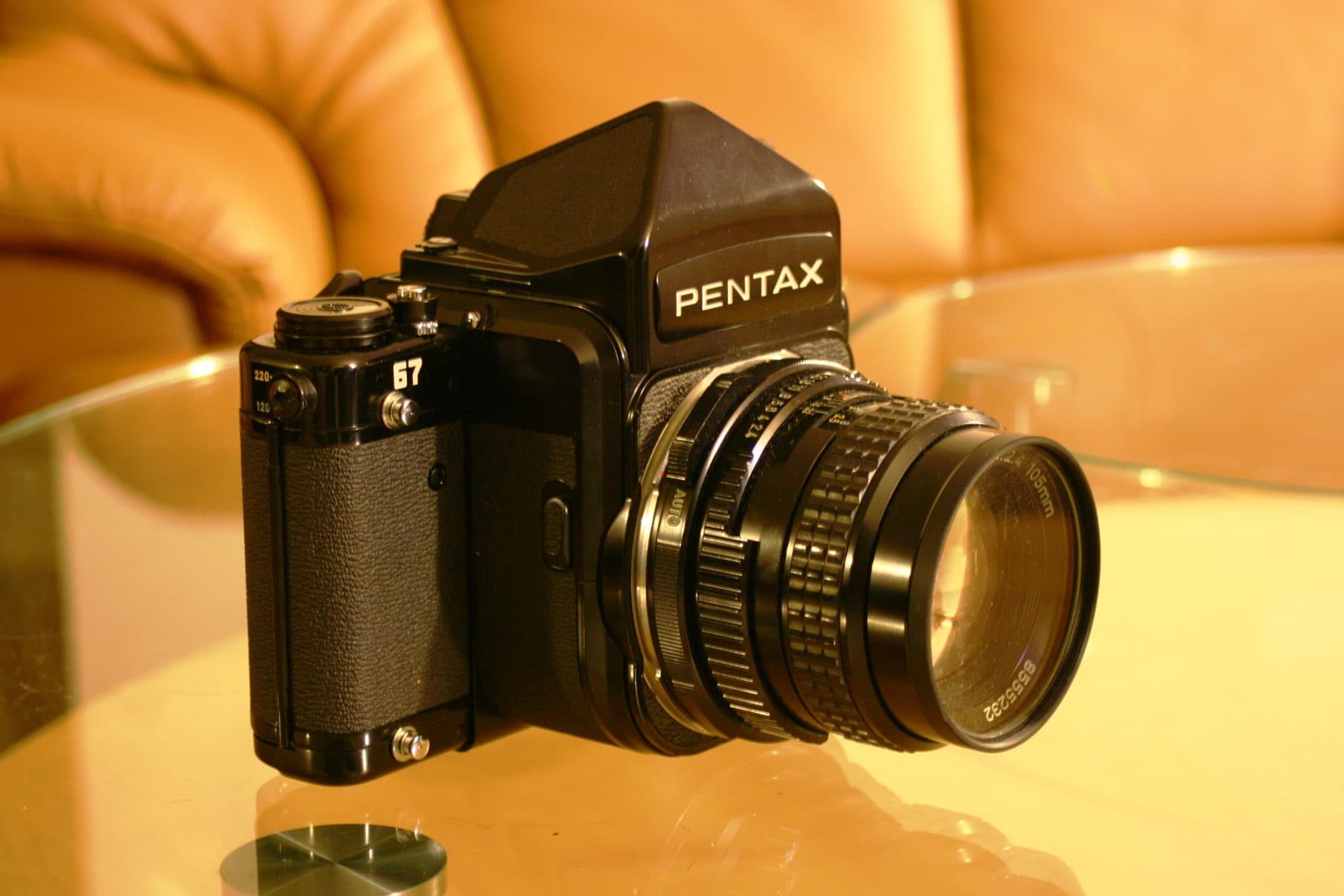
Verdict
The Pentax 67 delivers massive 6×7 negatives (10 shots per 120 roll) with interchangeable lenses including the legendary 105mm f/2.4 Planar. At 1,290g body-only (1,810g with TTL prism), it handles like an oversized 35mm SLR. The 105mm lens is genuinely one of the best ever made, delivering three-dimensional rendering. The weight and thunderous mirror slap limit handheld work, but for studio portraits and landscape photography, image quality is exceptional. Best value: Pentax 67 (1989 model) at $300-500.
Film photographers are divided on the Pentax 67: some call it one of the best medium format cameras ever made for its legendary 105mm f/2.4 lens and 6×7 negative size, while others find it too heavy and too cumbersome for anything beyond studio or landscape work. The debate centers on whether exceptional image quality justifies carrying nearly 5 pounds.
Background & Key Features
Pentax released the Asahi Pentax 6×7 in 1969, and it was genuinely revolutionary at the time. It took the familiar 35mm SLR design and scaled it up massively for 6×7 negatives. Pentax positioned it against Hasselblad and Mamiya, offering familiar SLR ergonomics at significantly lower cost, which made medium format accessible to more photographers.
Key features include 6×7cm format (10 frames per 120 roll), electronically controlled shutter (1 to 1/1000s, later 1/2000s), interchangeable prisms (waist-level, eye-level, TTL metered), mirror lock-up (1976+ models), extensive lens lineup (35mm fisheye to 1000mm telephoto), and aluminum chassis with wooden grip. Four versions were produced: 6×7 (1969), 6×7 MLU (1976), Pentax 67 (1989), and 67II (1998). Production ended in 2009.
The 67 (1989 model) offers the best value with electronic improvements and compatibility with all lenses at $300-500 versus $1,500-2,000 for the 67II. That's a significant price difference for relatively minor improvements.
Design & Handling
The Pentax 67 feels like a 35mm SLR on steroids, with the same control layout just massively scaled up. At 1,290g body-only, it's manageable for short periods. Add the TTL prism (520g) and 105mm lens (600g), and you're at 1,810g (4 lbs). After 20 minutes of shooting, neck and shoulder fatigue genuinely sets in. The camera demands frequent position changes, and you'll want a good strap.
Top-plate controls mirror 35mm SLRs: shutter speed dial on the left, film advance lever on the right, frame counter, rewind crank. The prism is interchangeable, so you can swap between waist-level, eye-level, or TTL metered depending on your needs. The viewfinder is bright but shows only 90% of the frame, which matters when composing carefully. The focusing screen is huge and clear, which makes manual focusing a pleasure. The wooden grip attaches to either side and is essential for carrying, though less useful for actual shooting.
The mirror slap is genuinely thunderous. Kids flinch. Family members laugh. It's not subtle, and it will draw attention. Film advance is smooth and satisfying. Loading film is fiddly, angling the 120 spool into place requires practice and patience. Mirror lock-up (available on 1976+ models) is absolutely critical for landscape work below 1/60s to avoid camera shake.
How the Pentax 67 Shoots: Portrait Photography and Landscape Photography Performance
Metering & exposure behavior
The TTL metered prism (optional, adds $100-150) offers center-weighted metering with in-viewfinder needle display. Metering is consistently accurate—photographers report never experiencing missed exposures. The TTL system reads through the lens, so ND filters work without compensation. Exposure compensation is available via the shutter speed dial. For portrait photography in natural light, the meter nails skin tones. For landscape photography, spot-metering critical areas and using exposure compensation ensures proper highlight retention.
Non-metered prisms require external meters. Many photographers prefer this—handheld incident meters provide more control for studio work and landscape photography where precision matters.
Focusing experience
Manual focus only. The large, bright focusing screen makes focusing easy in good light. The 105mm f/2.4 at f/2.4 has razor-thin depth of field—focus must be precise. The long focus throw on Pentax lenses provides fine control. For portrait photography, focus on the near eye. For landscape photography, use hyperfocal distance or focus one-third into the scene at f/11-16.
The 90% viewfinder coverage means unintended elements creep into frame edges. Check corners carefully before shooting.
Lens character & shutter performance
The SMC Pentax 67 105mm f/2.4 is genuinely legendary, one of the best lenses ever made for 35mm or medium format. It's sharp corner to corner even wide open at f/2.4, which is remarkable. The shallow depth of field on 6×7 format creates three-dimensional rendering that's hard to describe until you see it. Subjects pop from backgrounds with smooth, creamy bokeh that's almost painterly. By f/5.6, sharpness is exceptional across the entire frame.
Color rendition is neutral with high contrast. On Portra 400, skin tones are accurate with beautiful highlight rolloff. On Ektar 100, colors are saturated and punchy. On Tri-X 400, contrast is strong with excellent tonal separation that makes black and white sing.
The 105mm produces unique lens flare, an orange orb when shot into the sun. It's visible in the viewfinder, so you can compose it around subjects for creative effect. Shoot backlit, meter the shadows and add two stops, then compose the orb in shadow areas for dramatic portraits.
Other standout lenses include the 55mm f/4 Biogon (equivalent to 28mm, incredibly sharp for landscape photography), 90mm f/2.8 (closer minimum focus than the 105mm, available with leaf shutter for flash sync to 1/500s), and 165mm f/2.8 (equivalent to 85mm, excellent for portrait photography, compact at 835g, and shockingly cheap at $250).
The 1 to 1/1000s shutter (1 to 1/2000s on 67II) is adequate for most work. The 1/30s flash sync is limiting for ambient-balanced portraits, which is frustrating. The electronically controlled shutter requires batteries with no mechanical backup, so always carry spares.
Film pairings that sing
- Kodak Portra 400 for versatile portrait photography with beautiful skin tones
- Kodak Portra 160 for fine-grained studio work in controlled light
- Kodak Ektar 100 for saturated landscape photography with exceptional sharpness
- Ilford HP5 Plus or Kodak Tri-X 400 for black and white with strong contrast
- Ilford FP4 Plus for fine-grained black and white landscape photography
Best Uses: Portrait Photography, Landscape Photography, and Studio Work
Best at: Portrait photography (105mm f/2.4 legendary), landscape photography (6×7 format, mirror lock-up), studio work (tripod-based), fashion photography (used by Demarchelier, Testino)
Struggles with: Handheld work (weight and mirror slap), street photography (too heavy), travel photography (bulk), fast action (manual focus)
If this is you → pick this body:
- "I want maximum image quality" → Pentax 67
- "I need lighter medium format" → Mamiya 7 ($1,500-2,500)
- "I want modular system" → Mamiya RB67 ($300-500)
Pentax 67 vs Pentax 67II, Mamiya 7, and Mamiya RB67
The 67II offers a built-in grip, aperture priority mode, brighter screen, and 1/2000s shutter at $1,500-2,000 versus $300-500 for the original 67. The 67 delivers 95% of the image quality at one-fifth the price, which is the value proposition. The 67II also has circuit board failures that are expensive to repair, which makes the original 67 more reliable long-term.
The Mamiya 7 offers rangefinder design, lighter weight, and better portability at $1,500-2,500. But the maximum aperture is f/4, so you lose that shallow depth of field magic. The Mamiya RB67 offers a rotating back for switching between portrait and landscape orientation at $300-500, but it weighs 2,000g, which makes the Pentax 67 feel light by comparison.
Choose the Pentax 67 for legendary lenses and value. Choose the 67II for aperture priority. Choose the Mamiya 7 for travel. Choose the RB67 for rotating back.
* Prices as of December 2025. Pentax 67 offers exceptional value for image quality.
| Camera | Why choose it | Where it loses vs Pentax 67 | Typical used price* |
|---|---|---|---|
| Pentax 67II | Aperture priority, built-in grip, brighter screen, 1/2000s shutter | 4-5x the price, circuit board failures, heavier | $1,500-2,000 |
| Mamiya 7 | Rangefinder, lighter (1,750g), quieter, more portable | No f/2.4 lens, max f/4, more expensive | $1,500-2,500 |
| Mamiya RB67 | Rotating back, modular system, similar price | Heavier (2,000g), no 105mm f/2.4 equivalent | $300-500 |
Is the Pentax 67 Worth It in 2025?
As of December 2025, the Pentax 67 sells for $300-500 (body only), with 105mm f/2.4 at $500-700. This is exceptional value. You're getting 6×7 negatives and legendary glass at one-third the cost of a Mamiya 7.
Worth it if you shoot portrait or landscape photography where weight isn't a concern. The 105mm f/2.4 alone justifies the system. The weight and mirror slap are real, but for tripod-based work, image quality is exceptional.
Not worth it if you need portable medium format (get Mamiya 7) or shoot handheld street photography. The Pentax 67 is specialized for studio and landscape work.
For $800-1,200 (body + 105mm f/2.4), you get a system rivaling Hasselblad for image quality.
The Bottom Line
Buy it if
- You shoot portrait or landscape photography on tripod, want maximum image quality, and can handle 4+ pounds. The 105mm f/2.4 is legendary.
Skip it if
- You need portable medium format (get Mamiya 7), want rotating back (get Mamiya RB67), or shoot handheld street photography.
Consider it if
You're building a medium format system, want SLR ergonomics, or need extensive lens options from 35mm to 1000mm.
Frequently Asked Questions
Is the Pentax 67 worth it in 2025?
In 2025, the Pentax 67 sells for $300-500 (body only). It's absolutely worth it for portrait and landscape photographers. You're getting 6×7 negatives, legendary 105mm f/2.4 lens, and SLR ergonomics at one-third the cost of a Mamiya 7 ($1,500-2,500). The weight (4+ lbs with lens and prism) is real, but image quality is exceptional. This is the best value in medium format.
Pentax 67 vs 67II – which is better?
The 67II is objectively better: aperture priority, built-in grip, brighter screen, 1/2000s shutter. But it costs $1,500-2,000 versus $300-500 for the 67. The 67 delivers 95% of the image quality at one-fifth the price. Choose the 67II if you need aperture priority and budget allows. Choose the 67 for best value with the same legendary lenses. The 67II is known for circuit board failures.
Which Pentax 67 lenses are best?
The SMC Pentax 67 105mm f/2.4 is legendary—one of the best lenses ever made, sharp corner to corner with three-dimensional rendering. The 55mm f/4 is excellent for landscape photography. The 90mm f/2.8 and 165mm f/2.8 are both excellent for portrait photography. Start with the 105mm f/2.4—it's the cornerstone of the system.
Can you handheld the Pentax 67?
Yes, but it's challenging. At 4+ lbs with lens and prism, the weight causes fatigue. The thunderous mirror slap requires shutter speeds of 1/125s or faster for sharp handheld shots. Many photographers report sharp results at 1/60s with care. For shutter speeds below 1/60s, use mirror lock-up and tripod. The Pentax 67 is best suited for tripod-based work.
Pentax 67 vs Mamiya 7 – which is better?
Different shooting experiences. The Pentax 67 offers SLR ergonomics, legendary 105mm f/2.4 lens, and $300-500 pricing. The Mamiya 7 offers rangefinder design, lighter weight (1,750g), quieter operation, and better portability at $1,500-2,500. Maximum aperture on Mamiya 7 is f/4. Choose Pentax 67 for best value and f/2.4 lens. Choose Mamiya 7 for travel and portability.
What are common problems with the Pentax 67?
Common issues: mirror lock-up failures (early 6×7 models), film transport issues (clutch damage from pulling film backward), battery drain (67 model—battery holder tension spring disconnects), LCD bleed (67II), circuit board failures (67II). Before buying, check mirror lock-up function, test film advance, and inspect LCD. The 67 (1989 model) with mirror lock-up is most reliable. Budget for potential repairs.
Which Pentax 67 model should I buy?
Best value: Pentax 67 (1989 model) at $300-500. Avoid the original 6×7 without mirror lock-up (1969-1976)—reliability issues and expensive repairs. The 6×7 MLU (1976-1989) is good but older. The 67 (1989-1998) offers electronic improvements and best reliability. The 67II (1998-2009) is best but costs $1,500-2,000 and has circuit board issues. For most shooters, the 67 (1989 model) is the sweet spot.
Is the Pentax 67 good for landscape photography?
Yes, the Pentax 67 excels at landscape photography. The 6×7 format provides exceptional detail. Mirror lock-up (1976+ models) eliminates vibration for sharp shots. The 55mm f/4 lens is excellent for wide-angle landscape work. The weight (4+ lbs) is manageable on tripod. The extensive lens lineup covers 35mm fisheye to 1000mm. Many landscape photographers consider it one of the best medium format systems.
How many shots per roll on Pentax 67?
The Pentax 67 shoots 10 frames per roll of 120 film, or 20 frames on 220 film (no longer manufactured). The 6×7cm format is larger than 6×6 (12 frames) but provides more detail and native 4:5 aspect ratio for printing. At $15-20 per roll, that's $1.50-2.00 per shot. Plan your shots carefully.
Related reading
Related Topics
Join the iOS Beta
Join the beta to be the first to experience authentic film photography with Daydream Film.