
Camera Reviews
Nikon F100 Review: The Ultimate Film SLR Value
Daydream Editorial
· 8 min read
Verdict
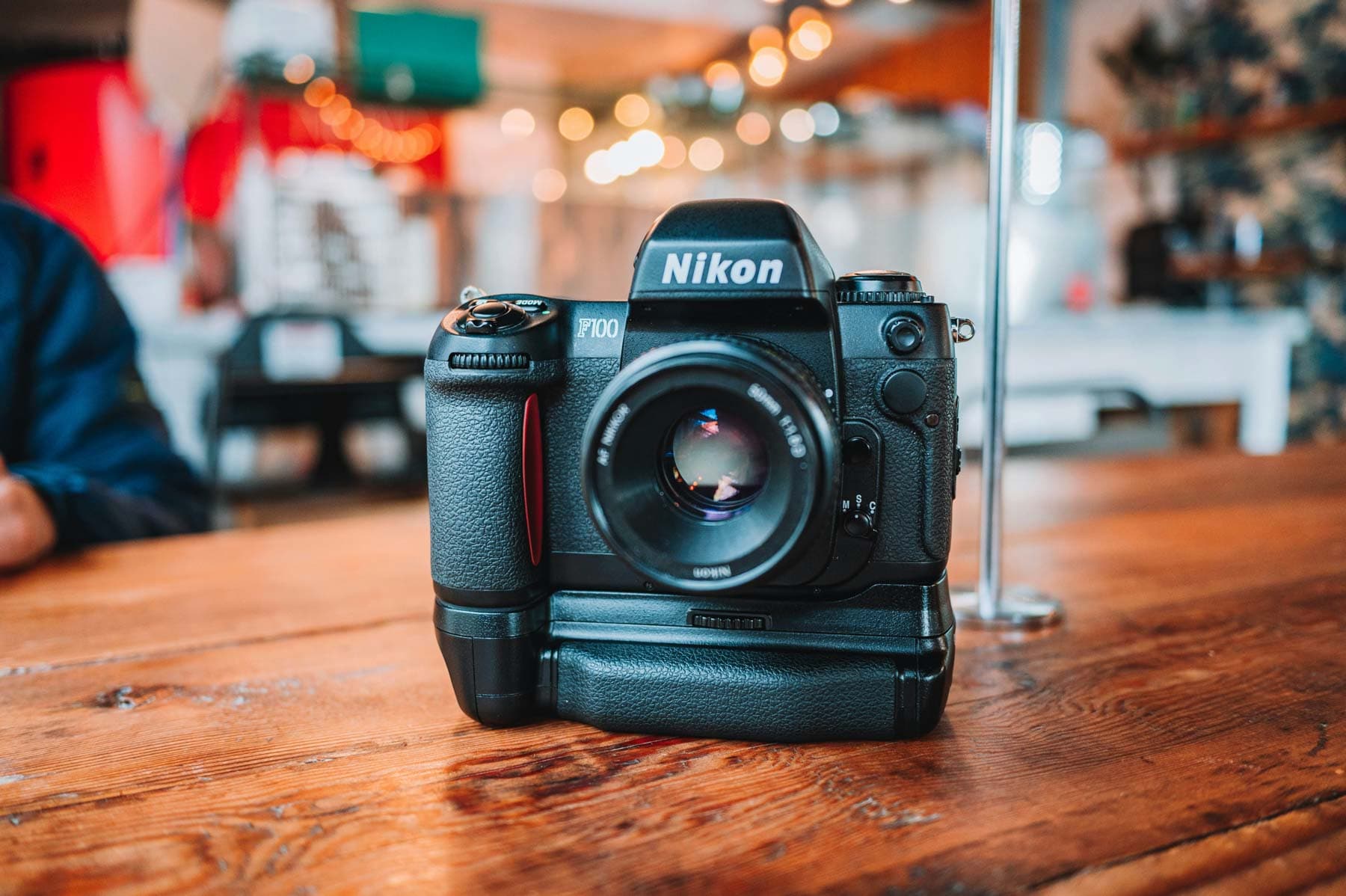
The Nikon F100 combines professional-grade autofocus, matrix metering, and build quality with modern ergonomics and compatibility with decades of Nikon glass. It's the most capable film SLR you can buy for under $300.
Film photographers debate whether the Nikon F100 is the best value in film photography or simply the best film SLR ever made. Released in 1999 as a prosumer alternative to the $3,000 F5, the F100 delivers 90% of professional features at one-third the cost. Today it sells for $150-250, making it absurdly affordable for what you get.
Background & Key Features
Nikon released the F100 in 1999 as their prosumer bridge between the enthusiast FE2 and the professional F5, and they absolutely nailed the formula. The F100 brought professional features to enthusiasts at an accessible price, delivering 90% of the F5's capabilities at one-third the cost. This 35mm SLR features a magnesium alloy body weighing 27.7 ounces (lighter than you'd expect), the Multi-CAM 1300 autofocus system with five cross-type sensors, and 10-segment 3D matrix metering that's genuinely excellent. The camera offers full PASM modes, shutter speeds from 30 seconds to 1/8000s, and 4.5 fps continuous shooting that's fast enough for most work.
It accepts four AA batteries (easy to find anywhere), syncs flash at 1/250s, and provides 96% viewfinder coverage (not 100%, but close enough). The F100 works with Nikon F-mount lenses from 1977 onward, giving you access to decades of excellent glass. Weather-sealed construction and 22 custom functions round out the professional feature set. Originally priced at $1,400, it competed directly with the $3,000 F5 by sacrificing mirror lockup, interchangeable prisms, and the F5's 1005-pixel RGB meter - features most photographers never use anyway.
Design & Handling
The F100 feels substantial at 27.7 ounces but balances beautifully with everything from a compact 50mm f/1.8 to a beast of an 80-200mm f/2.8. The magnesium alloy body is lighter than the F5 yet feels professional and weather-sealed—this is a camera you can trust in rain or snow. The molded rubber grip fits naturally in hand, though it can become sticky with age (a common issue with 1990s rubber). Controls mirror modern Nikon DSLRs, which means if you've used a D700 or D850, you'll feel right at home.
The viewfinder is bright with 96% coverage (not 100%, but honestly close enough for most work). Five autofocus points light up in red when selected, which is far easier to see than the F5's black LCD indicators that disappear in bright light. The top LCD shows all critical settings without removing your eye from the viewfinder, which is convenient. Button placement is genuinely excellent—mode, exposure compensation, and metering controls fall naturally under your fingers without hunting.
The shutter is quiet and smooth with a satisfying mechanical feel. Film advance via internal motor is fast and reliable at 4.5 fps. The camera loads film automatically: drop in the canister, pull the leader to the red stripe, close the back, tap the shutter. Done. The battery indicator shows only two bars (full or low), which isn't particularly informative. One weakness: the film door latch is plastic and prone to breaking with rough use, so be gentle.
How the Nikon F100 Shoots: Portrait Photography and Event Photography Performance
Metering & exposure behavior
The 10-segment 3D matrix metering is remarkably accurate, nailing exposure 90-95% of the time across diverse lighting conditions. The system analyzes scene brightness, contrast, and distance information from D-type lenses to calculate optimal exposure. In high-contrast situations, the meter occasionally underexposes by one stop when bright sky dominates the frame, but this is easily corrected with exposure compensation. Center-weighted metering biases 75% of the reading to the 12mm center circle, while spot metering offers five zones at 1% of the frame each. For event photography and portrait photography, the matrix metering handles mixed lighting confidently. The metering range extends from EV 0 to EV 21.
Autofocus performance
The Multi-CAM 1300 autofocus system is fast, accurate, and genuinely sophisticated for a film camera. Five sensors arranged in a cross pattern provide excellent coverage, with the center, left, and right sensors being cross-type for improved accuracy with both horizontal and vertical details. In Single Servo AF mode, the camera focuses once and locks—perfect for portraits. Continuous Servo AF tracks moving subjects continuously, which is essential for sports and event work. Dynamic AF mode allows the camera to track subjects across all five sensors, automatically switching between them as your subject moves—it's brilliant for unpredictable action.
Autofocus speed depends entirely on your lens choice. AF-S lenses with internal motors focus nearly silently and quickly, feeling modern and responsive. Older AF-D lenses use the camera's screw drive and are slightly slower with an audible motor sound, but still perfectly usable. In good light, the hit rate exceeds 90%—you'll be impressed by how reliably it nails focus. Low-light performance is solid down to EV 0, though the camera lacks an AF assist lamp, which can be limiting indoors. Focus tracking works brilliantly for moving subjects—sports, kids, events—the camera keeps up.
Lens character & image quality
Image quality depends entirely on your lens choice, and the F100 gives you access to decades of excellent Nikon glass. Modern AF-S lenses like the 50mm f/1.8G deliver tack-sharp results with fast, silent autofocus. Classic AF-D lenses like the 28-105mm f/3.5-4.5 provide excellent general-purpose performance. The camera meters accurately with D and G lenses but loses matrix metering with older manual focus glass. Older AI and AI-S lenses work in aperture priority mode but require manual focusing. Pre-AI lenses cannot be mounted safely. The F100 cannot use AF-P lenses or electronic aperture lenses.
Film Pairings That Sing
- Portra 400 for portrait photography and event work—forgiving latitude handles mixed lighting and skin tones beautifully
- Kodak Gold 200 for everyday shooting—affordable, reliable, and pairs perfectly with the accurate metering
- Tri-X 400 for black and white photography—classic pairing that showcases the F100's precise exposure control
- Ektar 100 for landscapes and fine detail—saturated colors and fine grain maximize lens sharpness
Best Uses: Portrait Photography, Event Photography, and Sports Photography
Best at: Portrait photography, event photography with reliable metering, sports photography with continuous AF tracking, street photography, wedding photography, studio work with flash sync
Struggles with: Extreme low-light without AF assist lamp, macro work without mirror lockup, landscape work requiring 100% viewfinder
If this is you → pick this body:
- "I want professional film SLR features without F5 weight or F6 cost" → Nikon F100
- "I need mechanical reliability and simpler operation" → Nikon FE2
- "Budget allows and I want the absolute best" → Nikon F6
Nikon F100 vs Nikon FE2, Canon F1, and Nikon F5
The F100 sits at the pinnacle of electronic film SLRs, but mechanical alternatives offer different strengths depending on what you value.
The Nikon FE2 delivers aperture priority automation, a blazing 1/4000s mechanical shutter, and simpler operation at $200-300. It's lighter, works without batteries, and is genuinely easier to operate. But you're giving up autofocus and that sophisticated matrix metering, which means you're back to manual focus and center-weighted metering. If you want mechanical reliability and don't mind manual focus, the FE2 makes sense.
The Canon F1 offers professional build and full manual control at $300-500, but it requires a completely different lens system. You can't use your Nikon glass, which is a dealbreaker if you're already invested. It works without batteries and has that brass-body mystique, but you sacrifice autofocus and modern features.
The Nikon F5 represents the F100's professional sibling with 1005-pixel RGB metering, 8 fps shooting, 100% viewfinder coverage, and mirror lockup at $400-600. It's objectively better on paper. But it's significantly larger, noticeably heavier, and requires eight AA batteries instead of four. For most photographers, the F100 delivers identical results in a more manageable package.
* Prices as of December 2025. Market fluctuates based on condition and demand.
| Camera | Why choose it | Where it loses vs F100 | Typical used price* |
|---|---|---|---|
| Nikon FE2 | Mechanical reliability, simpler operation, lighter weight | No autofocus, basic metering, slower shutter | $200-300 |
| Canon F1 | Professional build, mechanical operation, Canon glass | Different system, no autofocus, manual only | $300-500 |
| Nikon F5 | 1005-pixel meter, 8 fps, 100% finder, mirror lockup | Twice the weight, double batteries, higher cost | $400-600 |
Is the Nikon F100 Worth It in 2025?
As of December 2025, Nikon F100 bodies sell for $150-250 depending on condition, with pristine copies reaching $300. This represents extraordinary value—you're getting a professional-grade film SLR for less than many overhyped point-and-shoots. Today's used market pricing makes it arguably the best value in all of film photography.
Worth it if you want professional film SLR capabilities, modern ergonomics, and compatibility with decades of Nikon glass. Not worth it if you prefer mechanical simplicity, need to use pre-AI lenses, or want the lightest travel camera. The F5 offers marginal improvements at double the price and weight. The F6 costs $2000+ for features most photographers won't use. Bottom line: at $150-250, the F100 is the most capable film SLR you can buy for the money.
The Bottom Line
Buy it if
- You want professional film SLR performance with modern ergonomics, already own Nikon F-mount lenses, or need reliable autofocus.
Skip it if
- You prefer mechanical cameras without electronics, need to use pre-AI lenses, or want the lightest travel camera. Consider the FE2 instead.
Consider it if
You're transitioning from Nikon DSLRs to film, shoot events or portraits professionally, or want best value in film photography.
Frequently Asked Questions
Is the Nikon F100 worth it in 2025?
In December 2025, the Nikon F100 sells for $150-250 for working copies. It's absolutely worth it—you're getting professional autofocus, matrix metering, weather sealing, and modern ergonomics for less than overhyped point-and-shoots. The F100 delivers results identical to the $2000+ F6 for most shooting situations. If you want the best value in film photography and already own or can acquire Nikon F-mount lenses, the F100 is a no-brainer purchase.
Nikon F100 vs Nikon F5 – which is better?
The F5 offers 1005-pixel RGB metering (vs 10-segment), 8 fps (vs 4.5 fps), 100% viewfinder (vs 96%), and mirror lockup. The F100 counters with half the weight (27.7 oz vs 42.7 oz), half the batteries (four AA vs eight), and half the price ($150-250 vs $400-600). For 95% of photographers, the F100 delivers identical results in a more manageable package. Choose the F5 only if you need 8 fps for sports, mirror lockup for macro, or 100% viewfinder for critical framing.
What are common problems with the Nikon F100?
The most common issues are: plastic film door latch breaking (check before buying), sticky rubber grip degrading with age (cleanable with isopropyl alcohol), focus area selector becoming unresponsive (oxidation on contacts), and battery compartment corrosion from old alkalines. The camera may display "ERR" messages from dirty lens contacts or low batteries. Before buying, verify the door latch clicks securely, test all autofocus points with the D-pad, and check for battery compartment damage.
Which lenses work best with the Nikon F100?
AF-D and AF-S lenses work best, providing full matrix metering and autofocus. Modern AF-S lenses like the 50mm f/1.8G focus quickly and silently. Classic AF-D lenses like the 28-105mm f/3.5-4.5 provide excellent value. G-type lenses work perfectly despite lacking aperture rings. Older AI and AI-S lenses work in aperture priority but lose matrix metering and aperture display. Avoid AF-P lenses (incompatible) and pre-AI lenses (cannot mount safely).
Can the Nikon F100 handle sports photography?
Yes, the F100 excels at sports photography. The Multi-CAM 1300 autofocus system tracks moving subjects across five sensors in Dynamic AF mode, with focus tracking that anticipates subject position. Continuous Servo AF provides release priority for decisive moments. The 4.5 fps continuous shooting (5 fps with MB-15 grip) is adequate for most sports. Pair with fast telephoto lenses like the 80-200mm f/2.8 for professional results. Limitations: no mirror lockup and only five focus points compared to modern DSLRs.
Does the Nikon F100 work without batteries?
No, the F100 is entirely electronic and requires four AA batteries to operate. The shutter, metering, autofocus, and film advance all depend on battery power. This is a major difference from mechanical cameras like the FE2 or F3, which function without batteries (though losing metering). The upside: AA batteries are universally available, last for 10+ rolls, and the camera accepts rechargeable lithiums. Always carry spare batteries.
How does the Nikon F100 matrix metering work?
The F100 uses 10-segment 3D matrix metering that analyzes scene brightness, contrast, and subject distance (with D-type lenses) to calculate optimal exposure. The system compares readings against thousands of stored scenes to determine the best exposure. It works with D and G lenses but reverts to center-weighted metering with older manual focus glass. In practice, the meter nails exposure 90-95% of the time, handling everything from backlit portraits to high-contrast landscapes with minimal compensation needed.
What's the difference between the F100 and F6?
The F6 (2004) offers 11-area autofocus (vs 5), 1005-pixel RGB metering with manual focus lenses, mirror lockup, 100% viewfinder, and data recording. The F100 lacks these features but costs $150-250 versus $2000+ for the F6. For image quality and general shooting, they're virtually identical—same lens mount, same film, same basic capabilities. The F6 is the ultimate film SLR, but the F100 delivers 90% of the performance at 10% of the cost.
Related reading
Related Topics
Join the iOS Beta
Join the beta to be the first to experience authentic film photography with Daydream Film.