
Camera Reviews
Contax T3 Review: Titanium Perfection or Overhyped Luxury?
Daydream Editorial
· 8 min read
Verdict
The Contax T3 is a razor-sharp, titanium-bodied compact with a stellar 35mm f/2.8 Zeiss Sonnar lens that delivers exceptional image quality in a pocketable package. It's the most refined premium compact ever made, but the $1,200-1,800 price tag in December 2025 makes it a luxury purchase, not a practical one.
Film photographers are split on the Contax T3: some call it the pinnacle of compact camera design with its titanium body and Zeiss Sonnar lens, others dismiss it as an overpriced status symbol trading at $1,200+ purely on brand cachet. The debate centers on a simple question: does titanium construction and marginal improvements over the T2 justify double the price?
Background & Key Features
Kyocera released the T3 in 2001 as Contax's final premium compact, and they went out with a statement. The T3 arrived as the refined successor to the T2, cutting the T2's size by a third while upgrading to a true 35mm focal length (versus the T2's 38mm). It was the culmination of everything Contax learned about building premium compacts, and it shows.
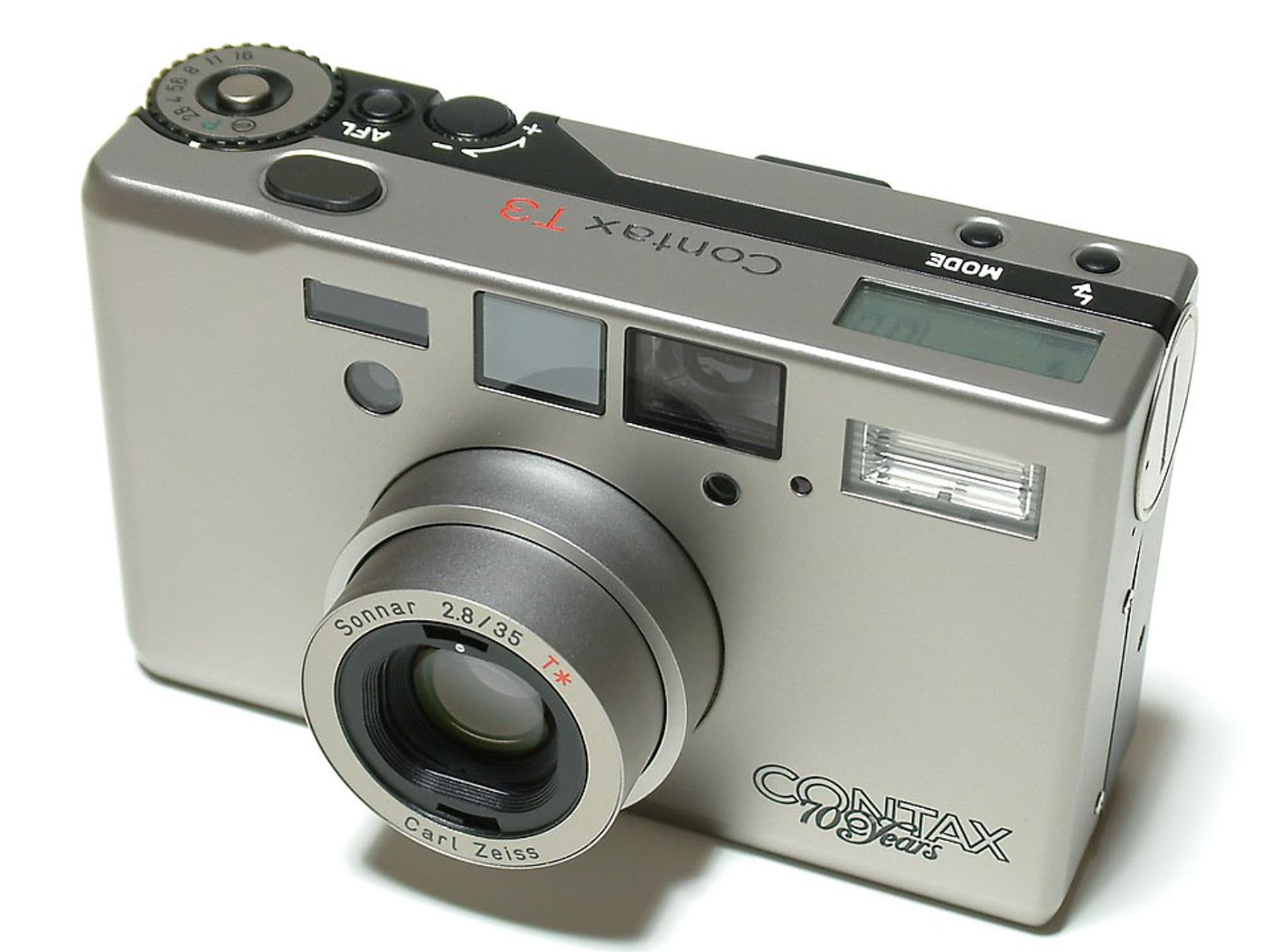
The titanium body houses a Carl Zeiss Sonnar 35mm f/2.8 lens with T* coating, focusing down to 35cm—half the T2's minimum distance, which opens up close-up work that was impossible before. Notable features include aperture priority mode, exposure compensation, manual focus by distance, synthetic sapphire shutter button and viewfinder glass (because why not use literal gemstones?), and seven customizable functions that let you tailor the camera to your shooting style. At $1,000 new in 2001, it targeted photographers who wanted premium refinement without rangefinder commitment or interchangeable lens complexity.
Then celebrity sightings happened. Drake, Kendall Jenner, and others were spotted using it, and prices went absolutely bonkers—from reasonable to stratospheric. Now you're looking at $1,200-1,800 for a 24-year-old electronic camera with no repair support. That's the reality we're working with.
Design & Handling
Pick up a T3 and the first thing you notice is how impossibly dense it feels—170g packed into dimensions smaller than a deck of cards. It's like holding a very expensive paperweight that happens to take photos. It disappears into a jacket pocket but has enough weight to steady handheld shots, which is the sweet spot. The smooth titanium finish isn't slippery, but given the replacement cost, use a wrist strap anyway. The boxy shape fits the palm surprisingly well, though your fingers will occasionally brush the lens on power-up until you learn the grip.
The viewfinder is bright and contrasty with that synthetic sapphire glass (fancy), showing focus distance, shutter speeds, and exposure info. It lacks parallax correction, which is a bummer, and eyeglass wearers will struggle with the limited eye relief. Frame lines wash out in bright light, which happens more often than you'd like.
The shutter is discreetly quiet—perfect for candid street work where you don't want to announce you're shooting. The lens extends with a soft whir that's pleasant rather than mechanical. One quirk that'll annoy you: the camera forgets settings when powered off, defaulting to program mode every single time (though exposure compensation locks with custom function 3c, thankfully). Aperture priority requires pressing a center button to unlock the dial, which is fiddly but you adapt.
How the Contax T3 Shoots: Street Photography and Travel Photography Performance
Metering & exposure behavior
The center-weighted meter updates constantly in the viewfinder, displaying approximate shutter speeds (LT for long time, 30, 125, 500) rather than exact values. In practice, you learn to read these quickly: LT blinking means use flash or find a tripod, 30 means brace yourself and pray, 125 handles walking subjects comfortably, 500 means shoot freely without worry. The meter nails exposure consistently, even in high-contrast situations where cheaper cameras would blow highlights or crush shadows. For night photography, the 1-second minimum shutter limits handheld work unless you're braced against something solid, but that f/2.8 lens helps when you've got a tripod. The meter goes down to 1EV, handling genuinely dim conditions admirably.
Focusing experience
Phase-detection AF is fast and accurate, landing 85-90% of shots sharp in good light. The 35cm minimum focus opens up portrait photography and close-up work that the T2's 70cm limit prevented. For street photography, you can lock manual focus at 5m and shoot at f/8 for a depth of field covering 2.5m to infinity. Custom function 2 lets you choose whether the lens moves on half-press (faster feel) or full press (quieter operation). Low-light AF hunts occasionally, but switching to manual focus with the AFL button solves this.
The AFL button locks focus independently from exposure, enabling precise control over what you meter versus what you focus on. Hold AFL for a second to lock focus, then half-press to meter elsewhere and reframe. Custom function 6b maintains the locked distance until reset, effectively turning AFL into a quick manual focus system that's faster than diving into the menu.
Lens character & image quality
Let's talk about why this camera costs what it does: the 35mm f/2.8 Zeiss Sonnar is genuinely exceptional. Wide open, it's razor-sharp in the center with slight softness in the corners that adds character rather than looking like a flaw. By f/5.6, sharpness is perfect edge-to-edge, resolving detail right up to the grain limits of film. You're not leaving anything on the table. Vignetting appears at f/2.8 but is subtle compared to the T2's more pronounced darkening—it's there if you look for it, but it doesn't dominate the image.
Color rendition shows that classic Zeiss microcontrast and pop that makes images feel three-dimensional. On Ektar 100, colors are vibrant with punchy saturation and excellent separation between tones. On Portra 400, skin tones are smooth with gentle highlight rolloff that flatters portraits. Black and white film reveals stunning tonal gradation—shoot Tri-X and you'll get rich midtones and deep blacks that make you understand why people pay for Zeiss glass.
Bokeh at f/2.8 is smooth with nicely rounded out-of-focus highlights and no harsh fringes or onion rings. It's not going to compete with an 85mm f/1.4, but for a compact it's lovely. Low-light performance is excellent, with the f/2.8 aperture and high lens transmission producing dense, rich negatives even in challenging conditions.
Flare resistance is superb—genuinely impressive. Shooting nearly into the sun produces minimal veiling flare. The T* coating earns its reputation here. Contrast remains high even in backlit situations where lesser lenses would wash out.
Film pairings that sing
- Portra 400 for versatile shooting with beautiful skin tones and forgiving latitude (perfect for the T3's accurate meter)
- Ektar 100 for vibrant color and maximum sharpness to match the lens's resolving power
- Kodak Gold 200 for warm tones and affordable everyday shooting that still looks gorgeous
- Tri-X 400 for classic black and white with rich contrast that complements the Zeiss microcontrast
Best Uses: Urban Photography, Portrait Photography, and More
Best at: Street photography (quiet shutter, fast AF), travel photography (small, reliable meter), urban photography (35mm focal length), portrait photography (35cm close focus), documentary work
Struggles with: Night photography (1s minimum shutter), fast action (no continuous AF), macro work (35cm minimum), budget shooting (repair costs astronomical)
If this is you → pick this body:
- "I want premium build in a pocketable camera" → Contax T3
- "I need more manual control" → Contax T2
- "Budget-conscious" → Olympus Mju-II
Contax T3 vs Contax T2, Ricoh GR1v, and Olympus Mju II
The T2 offers more tactile controls with its lens-mounted aperture ring and stronger vignetting that some people love, but it's significantly larger and heavier—you'll feel the difference in your pocket. The T2 also has that 38mm focal length versus 35mm, which is a subtle but real difference in framing.
The Ricoh GR1v matches the T3 for size with genuinely better ergonomics and a 28mm lens option that's excellent for street work. But build quality feels less premium (it's good, just not titanium-and-sapphire good), and reliability is questionable—LCD failures plague the entire GR series. Finding a working copy is harder than it should be.
The Olympus Mju-II delivers sharp 35mm f/2.8 optics at a fraction of the cost—$200-350 versus $1,500+. It's plastic, lacks manual controls entirely, but it just works and produces excellent results. For most people, this is the smart choice.
Choose the T3 for the absolute best build quality and Zeiss rendering in the smallest premium package. Choose the T2 for more hands-on control and that specific 38mm character. Choose the Ricoh GR1v for better ergonomics and 28mm perspective if you can find a working one. Choose the Olympus Mju-II to save $1,300 and still get great photos.
* Prices as of December 2025. Market fluctuates significantly based on condition and celebrity influence.
| Camera | Why choose it | Where it loses vs Contax T3 | Typical used price* |
|---|---|---|---|
| Contax T2 | Larger aperture ring, more lens character, 38mm focal length | Significantly larger and heavier, 70cm minimum focus | $800-1,200 |
| Ricoh GR1v | Superior ergonomics, 28mm focal length option, similar size | Less premium build, notorious reliability issues | $600-900 |
| Olympus Mju-II | Excellent optics, lightweight, reliable, affordable | No manual controls, plastic build, less refined | $200-350 |
Is the Contax T3 Worth It in 2025?
As of December 2025, the T3 sells for $1,200-1,800 (black models $2,000+). Prices have tripled from five years ago, driven by celebrity sightings and film's resurgence. Yes, it's partially overhyped. The Olympus Mju-II delivers 80% of the image quality at 15% of the cost. What you're paying for: titanium construction, aperture priority, Zeiss pedigree, and smallest premium compact ever made.
Worth it for experienced photographers who value premium build and pocketability, with budgets allowing guilt-free luxury purchases. Not worth it if buying on hype, stretching financially, or won't use manual controls. Alternatives: T2 offers similar quality for less; Mju-II saves $1,300+; GR1v provides comparable features for $700 less. Right for the right shooter with the right budget.
The Bottom Line
Buy it if
- You want the best-built premium compact, value titanium and Zeiss optics, shoot aperture priority regularly, and $1,500 won't keep you up at night.
Skip it if
- You're buying on hype, stretching your budget, or won't use manual controls. Get a Mju-II for $200.
Consider it if
You've exhausted cheaper alternatives and need the smallest premium compact, or you're a collector.
Frequently Asked Questions
Is the Contax T3 worth it in December 2025?
In December 2025, the Contax T3 sells for $1,200-1,800. It's worth it for photographers who value premium titanium construction, aperture priority control, and exceptional Zeiss optics in the smallest premium compact ever made. However, if budget is a concern, the Olympus Mju-II delivers 80% of the image quality at $200-350. In short, if you want the absolute best-built pocket camera and price isn't a barrier, the T3 will delight you; otherwise, cheaper alternatives offer better value.
Contax T3 vs Contax T2 – which is better?
The T3 is smaller and lighter with a true 35mm lens and 35cm minimum focus (versus T2's 38mm and 70cm). The T2 offers more tactile controls with its lens-mounted aperture ring and arguably more lens character through stronger vignetting. Choose the T3 for ultimate pocketability and close-focus capability. Choose the T2 if you prefer hands-on control and don't mind carrying a larger camera. Both deliver exceptional Zeiss image quality.
What are common problems with the Contax T3?
The most common issues are: electronic failures (LCD bleed, meter malfunction, AF failure) as capacitors age, lens extension problems from worn gears, and battery door latch breakage. Before buying, test all functions thoroughly, check for smooth lens operation, and inspect the battery door. Factor in that repairs are nearly impossible (Kyocera no longer supports Contax), making a broken T3 an expensive paperweight. Buy from reputable sellers with return policies.
Which film should I start with on the Contax T3?
Start with Portra 400 for its forgiving latitude, beautiful colors, and versatility in varying light. The T3's accurate meter pairs perfectly with Portra's wide exposure range, minimizing risk of blown highlights or muddy shadows. The combination delivers gorgeous skin tones for portraits and smooth color transitions for street and travel work. Once comfortable, try Ektar 100 for maximum sharpness or Tri-X 400 for classic black and white.
Can the Contax T3 handle street photography?
Yes, the T3 excels at street photography. The quiet shutter is discreet for candid work, fast AF locks focus quickly, and the pocketable size means you'll actually carry it everywhere. The 35mm focal length is ideal for street scenes. For zone focusing, lock manual focus at 5m and shoot at f/8 for a depth of field covering 2.5m to infinity. The only limitation is low-light AF hunting, solved by switching to manual focus.
How does the Contax T3 perform in low light?
The f/2.8 lens helps in low light, and the meter goes down to 1EV for dim conditions. However, the 1-second minimum shutter speed limits handheld night photography. For night work, use a tripod or solid surface for longer exposures. The AF can hunt in very low light; switch to manual focus and lock the lens at a preset distance for faster operation. Push film like Portra 800 or Tri-X to 1600 for better handheld capability.
Is the synthetic sapphire shutter button actually useful?
Honestly, it's more marketing than meaningful feature. The sapphire shutter button and viewfinder glass are scratch-resistant and look nice, but they don't significantly impact shooting experience. The bright viewfinder is genuinely helpful, but whether that's due to sapphire versus quality glass is debatable. The shutter button feels good but no different from the T2's standard button. It's a luxury detail that adds to the premium feel but isn't a reason to buy the camera.
Should I get the black or silver Contax T3?
The silver titanium finish is more affordable ($1,200-1,500) and shows wear less obviously. The black limited edition commands $2,000+ and is harder to find. Functionally, they're identical. Choose silver for better value and availability. Choose black only if you're a collector or strongly prefer the aesthetic and don't mind paying a 50%+ premium. The silver finish is beautiful and more practical for actual shooting.
Can I use the Contax T3 for portrait photography?
Yes, the T3 works well for portraits. The 35cm minimum focus (versus T2's 70cm) allows closer framing, and f/2.8 provides some subject separation. The 35mm focal length is wider than ideal for tight headshots but perfect for environmental portraits. The accurate meter handles skin tones well, especially with Portra film. For best results, shoot at f/2.8 for background blur, use the AFL button to lock focus on eyes, and meter off skin tones in even light.
Related reading
Related Topics
Join the iOS Beta
Join the beta to be the first to experience authentic film photography with Daydream Film.